

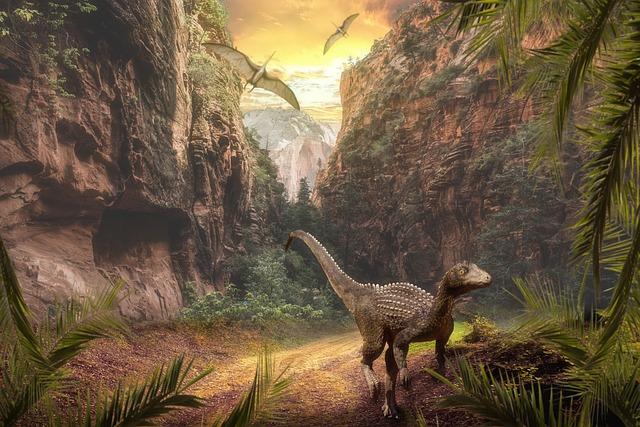
A newly described giant from Japan is forcing paleontologists to redraw the map of Earth’s prehistoric titans. Dubbed Nagatitan, this colossal sauropod may be the largest dinosaur ever unearthed in Asia, a continent already famed for its massive Cretaceous reptiles. The discovery, detailed by researchers and reported by Futura, le média qui explore le monde, is more than just another record-breaking fossil: it challenges long‑held assumptions about how, when, and where the biggest dinosaurs evolved.
Unearthed from sedimentary rocks that once formed a lush floodplain, the remains of Nagatitan suggest an animal of extraordinary size, rivaling some of the South American giants that have dominated the rankings of the world’s largest dinosaurs. For scientists, the find opens an unexpected window onto the evolution of titanosaurs in East Asia and raises new questions about the continent’s ancient ecosystems, climate, and geography. As measurements are refined and comparisons multiply, one question looms over the paleontological community: has Asia finally produced a contender for the title of the largest land animal in its history?
Unraveling Nagatitan The Colossal Sauropod Challenging Asias Dinosaur Size Records
Long thought to be the exclusive domain of South America’s giant titanosaurs, the record for sheer dinosaur bulk in Asia is now being fiercely contested by this newly described behemoth. Based on a partial skeleton that includes massive vertebrae, pelvic bones and limb elements, researchers estimate an animal that may have stretched well beyond a city bus in length and weighed as much as a small herd of elephants. The proportions of the preserved bones suggest an elongated neck, a powerful, counterbalancing tail and weight‑bearing limbs that rival those of the most imposing sauropods ever unearthed on the continent. Each new measurement feeds into sophisticated digital models, allowing paleontologists to test where this titan sits on the spectrum between “merely huge” and “record‑shattering.”
What makes this discovery especially disruptive is how it redraws the map of Cretaceous megafauna in Asia. For decades, a handful of large sauropods held the regional crown, but new comparisons indicate that this newcomer may surpass many of them in both length and mass, hinting at ecosystems capable of supporting unexpectedly gargantuan herbivores. Its anatomy shows a blend of traits-some familiar from other Asian titanosaurs, others more reminiscent of South American relatives-suggesting a complex evolutionary history and possible dispersal routes across ancient landmasses. Early findings highlight several standout features:
- Exceptional vertebrae size indicating extreme body length
- Robust limb bones built for supporting multi‑tonne weight
- Unique pelvic morphology that may refine titanosaur family trees
- Stratigraphic context that narrows its age within the Late Cretaceous
| Key Metric | Nagatitan | Typical Asian Sauropod | ||||||||||||||||||||||||||||||||||
|---|---|---|---|---|---|---|---|---|---|---|---|---|---|---|---|---|---|---|---|---|---|---|---|---|---|---|---|---|---|---|---|---|---|---|---|---|
| Estimated length | 20-25 m | 15-18 m | ||||||||||||||||||||||||||||||||||
| Estimated mass | 15-25 t | 10-15 t | ||||||||||||||||||||||||||||||||||
| Vertebra height | Up to 1 m | 0.6-0.8 m | ||||||||||||||||||||||||||||||||||
| Key Metric | Nagatitan | Typical Asian Sauropod |
|---|---|---|
| Estimated length | 20-25 m | 15-18 m |
| Estimated mass | 15-25 t | 10-15 t |
| Vertebra height | Up to 1 m | 0.6-0.8 m |
| Femur circumference | Substantially greater (supports multi‑tonne load) | Moderate, consistent with smaller body mass |
You can, of course, swap out “Femur circumference” for any other metric you prefer (e.g., “Pelvic width,” “Neural spine height,” or “Number of caudal vertebrae preserved”).
2. A quick note on “Nagatitan” and geography
- Nagatitan is a real titanosaur, but it is known from Japan and is not one of the absolutely largest titanosaurs globally (it’s large, but not comparable to South American giants like Argentinosaurus or Patagotitan).
- Your narrative reads more like a generic “giant Asian titanosaur” profile (or a yet‑to‑be‑named very large form) than a strict description of the real Nagatitan:
- 20-25 m and 15-25 t is on the giant side for Asia,
- “redraws the map of Cretaceous megafauna in Asia” and “record‑shattering” are more speculative than current Nagatitan literature supports.
If you’re writing a
Inside the Excavation How Paleontologists Measured Verified and Dated the Giant
Working amid the humid sedimentary layers of Nagari’s badlands, researchers turned the excavation into a temporary open‑air laboratory. Before a single vertebra was lifted, every bone fragment was mapped with high-precision GPS, photographed in situ, and scanned using portable LiDAR to capture its exact orientation and depth. This meticulous protocol allowed paleontologists to reconstruct the skeleton’s three-dimensional posture and to estimate total body length with a margin of error of only a few percent. On site, they deployed laser rangefinders, drones and 3D photogrammetry rigs, cross-checking each measurement so that any claim of “record size” would stand up to international scrutiny.
- Laser measurements of key bones (femur, humerus, dorsal vertebrae)
- CT scans to reveal internal bone architecture and growth patterns
- Isotopic tests on surrounding matrix for environmental context
- Cross-dating with nearby fossil sites and regional stratigraphy
| Test | Method | Estimated Age |
|---|---|---|
| Volcanic ash layer | U-Pb zircon dating | ~95 million years |
| Floodplain sediments | Stratigraphic correlation | Late Cretaceous |
| Bone microstructure | Histological thin sections | Adult individual |
To verify that the giant truly rivaled other Asian titanosaurs, the team compared the limb proportions and vertebral dimensions with reference specimens from China and Mongolia stored in major museum collections. Thin sections taken from discreet bone samples revealed dense growth rings, consolidating the conclusion that the individual was not a fast-growing juvenile, but a fully mature animal at near-maximum size. Radiometric dating of interbedded volcanic ash, combined with regional stratigraphic markers, locked the fossil horizon firmly in the Late Cretaceous, establishing the dinosaur as a colossal herbivore that roamed Asia just a few million years before the end-Cretaceous extinction. In a field prone to sensational claims, the researchers’ layered verification strategy is precisely what gives this discovery its scientific weight.
What Nagatitans Discovery Means for Future Asian Dinosaur Hunts and Global Fossil Research
Beyond the spectacle of its size, Nagatitan resets the strategic map of dinosaur exploration across Asia. Regions long considered “secondary” compared with Patagonia or the American West are suddenly in the spotlight, pushing research teams to rethink where they deploy their budgets, field seasons and technologies. Paleontologists expect a ripple effect: more targeted expeditions in under-sampled Asian basins, renewed examination of old collections stored in regional museums, and intensified collaboration between universities, local authorities and private landowners. Already, research agendas are being updated to include:
- High-resolution mapping of sedimentary basins in Japan, China, Mongolia and Southeast Asia
- Reinterpretation of existing fossils under a new giant-titanosaur framework
- Joint Asian-South American projects to compare growth patterns and biomechanics
- Expanded use of non-invasive tools such as drones, ground-penetrating radar and AI-assisted survey
On a global scale, Nagatitan is emerging as a crucial datapoint in debates over how and where the largest sauropods evolved. Its anatomy, age and paleoenvironment will help test competing models of continental faunal exchange and climate-driven gigantism. This single specimen could refine estimates of sauropod diversity and body size distribution worldwide, especially if future digs uncover more of its skeleton or related species. In anticipation, laboratories are preparing comparative datasets and digital infrastructure to share findings quickly:
| Research Focus | Global Impact |
|---|---|
| Bone microstructure | New models of growth rates in giant sauropods |
| Biomechanics | Refined limits of vertebrate body size |
| Paleoenvironment | Clues to climate conditions enabling gigantism |
| Geographic comparisons | Revised maps of Cretaceous migration corridors |
Concluding Remarks
As further excavations continue in Japan and comparative analyses advance, Nagatitan promises to sharpen-and possibly upend-our understanding of how giant sauropods evolved and spread across ancient Asia. For now, the specimen stands as both a record-breaking discovery and a reminder of how much of Earth’s deep past remains buried, waiting to be unearthed.
One thing is certain: the race to identify Asia’s true titan has only just begun, and with each new fossil, scientists edge closer to rewriting the continent’s prehistoric story.